Toward closed-loop control of upper-limb prostheses
The recent development of actuated upper limb prostheses aims to improve the quality of life of paralyzed or amputated patients. One challenge towards this goal is the integration of tactile and proprioceptive information from the periphery, both by robotic actuators, and by the patients themselves.
Beyond prosthetic applications, furthering our understanding of the closed-loop nature of motor control is a fundamental goal of neurosciences, and will nurish the bio-inspiration of robot control strategies.
This highly interdisciplinary topic sits at the border of neurophysiology, robotics and biomechanics. NeuroControl 2026 aims to be a forum to cross these discipline boundaries. It will gather motor physiologists, specialists of prosthetics and of biomechanics.
Keynote speakers
Daniel Häufle, Professor, Tübingen Universität, Germany. Morphological computation in neuro-muscular control of movement.
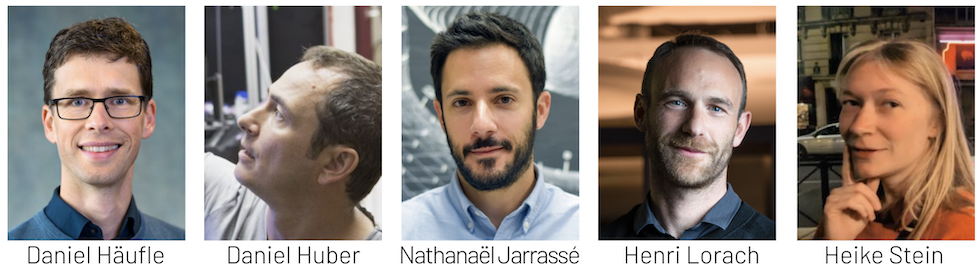
Daniel Huber, Associate Professor, Université de Genève, Switzerland. Cortical circuits involved in voluntary action.
Nathanaël Jarrassé, CNRS research director, Institute for intelligent systems and Robotics, (ISIR) Sorbonne Université, Paris. Movement-based control approaches of upper-limb prostheses.
Henri Lorach, Assistant Professor, Université de Lausanne, Switzerland & part of NeuroRestore. Brain-controlled spinal cord stimulation to restore movement after paralysis.
Heike Stein, CNRS researcher, Institute for intelligent systems and Robotics, (ISIR) Sorbonne Université, Paris. Learning to walk on complex surfaces: the emergence of coordinated locomotion in mice.
Contribute to the conference
Short talks and posters will be selected from the abstracts submitted on this website. Space is limited: short talk abstracts that cannot be selected for oral presentation will be considered for a poster slot. Submission deadline: March 15th!
Registration is free but mandatory if you plan to attend.
Organizing committee
Luc Estebanez (CNRS, NeuroPSI), Antoine Chaillet (CentraleSupélec, L2S) and Maria Makarov (CentraleSupélec, L2S).
Sponsors
We thank H-Code (interdisciplinary object, Université Paris-Saclay), CNRS Prime and Region Ile-de-France DIM C-Brain for essential funding of the conference.